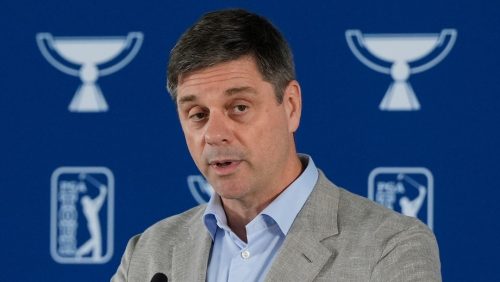






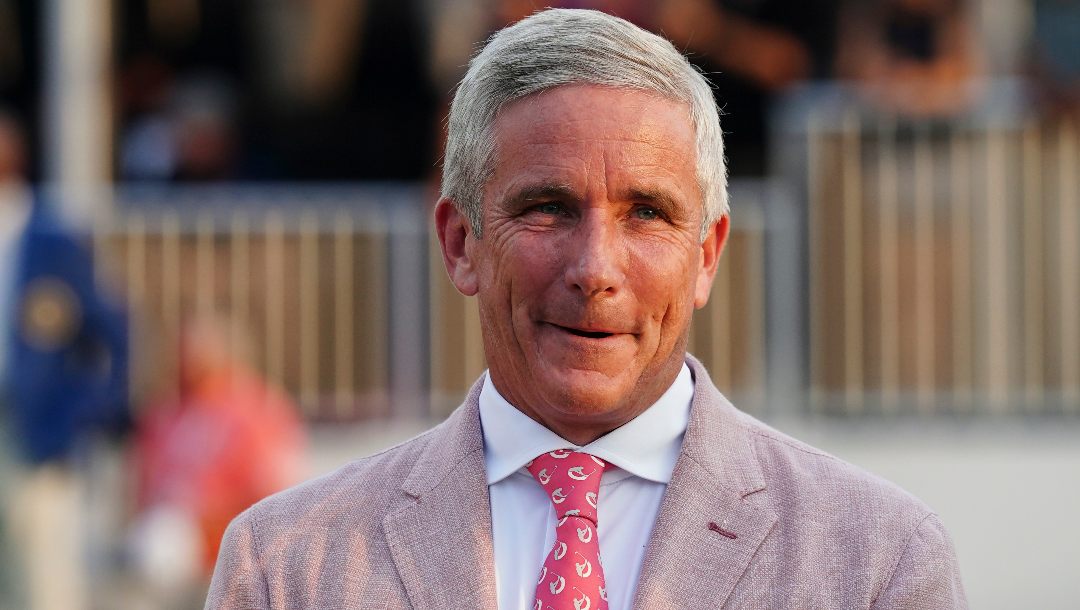
On Tuesday morning, during his annual State of the PGA Tour press conference in advance of this week’s Players Championship, PGA Tour commissioner Jay Monahan once again addressed the biggest elephant in professional golf’s increasingly melancholy room.
It was 644 days ago when Monahan announced that the PGA Tour had entered into a framework agreement with the Public Investment Fund of Saudi Arabia, yet it remains clear that these ongoing discussions continue to be all framework and no agreement.
Whether it’s the commissioner himself or Tiger Woods or Rory McIlroy or anyone else with some inside knowledge on negotiations regarding reunification, the spectrum of optimism to pessimism has bounced like the stock market, the only sure thing to emerge being this volatility.
Well, that’s not entirely true.
We’re sure of one other thing: The world of professional golf absolutely needs reunification.
We know this because Monahan has constantly reminded us of this, despite the fact that the major championships – none of which are owned and operated by the PGA Tour, of course – have seemed to achieve even greater importance with all of the game’s best players only competing against each other four times each year.
Even Monahan is contradicting himself, telling us that reunification is an indisputable necessity, while also explaining that LIV Golf’s disruption has “generated momentum, growth and real action” for the PGA Tour.
It’s enough to leave the rest of us asking a simple question with so many complicated answers: Why?
Why does the PGA Tour feel the need to make a deal with the PIF? Why does it feel the need to reintegrate players who left for greater riches? Why does it want to welcome back those who caused this disruption?
These queries have served as a rallying cry for PGA Tour supporters who have taken a “good riddance” stance against the likes of Jon Rahm, Brooks Koepka, Bryson DeChambeau and Phil Mickelson. If they didn’t want to stay, the theory goes, the PGA Tour shouldn’t be bending over backward to try and bring them back.
It’s a salient point – perhaps the most salient point in these murky waters of rhetoric and rigamarole.
The answer lies less in the present than the future.
For a majority of the 21 months that the PGA Tour and PIF have been negotiating, the latter has essentially called off the proverbial dogs. Maybe those who remained loyal have little interest in joining the exodus, but it’s obvious that the rumor mill has stopped churning.
Which only makes sense. Hey, why try to beat ‘em when you can join ‘em?
Golf is a game of risk-reward, so now let’s consider the risk if Monahan sat in front of the cameras and microphones and announced that the PGA Tour was no longer interested in trying to join forces.
Perhaps the reward would be a celebration of the reluctance for compromise, the players rallying around the decision to continue segregation between these two factions.
Or maybe the PIF would simply find a few billion more in the coffers and renew its membership drive, attempting to buy the allegiance of any and every superstar who’s previously alleged that he’d never leave.
Maybe they’d go after youngsters like Luke Clanton and Gordon Sargent and Jackson Koivun, pillaging the supply of future PGA Tour stalwarts before they ever reached that level.
It’s easy enough to suggest that the PGA Tour should stop negotiating with the proverbial enemy, but this resolves to a high-stakes game of chicken which could horribly backfire.
All of which leads back to that original question: Why?
The public response is that these negotiations are being done for the fans, that the PGA Tour wants to provide the ultimate product to the public and it can’t do that without including all of the world’s best players.
It’s a neat response – and it surely isn’t fraudulent.
The more relevant answer, though, is that it’s all about self-preservation. This has less to do with maintaining the status quo – or improving it – than it does with ensuring there’s a future which remains brighter than the opposition.
As long as the PGA Tour continues trying to build on this framework agreement, as long as there’s an effort to persist with negotiations, Monahan and Co. can hold that opposition at bay, staving off another potential onslaught of their most valuable resource.
Continuing to negotiate with the PIF accomplishes that feat. The alternative could be catastrophic.


Cash Back for 2nd Place
If your golfer doesn’t win the tournament, you’ll still get cash back if they finish in second place!
Log in to your account for full terms and info.
The content provided in this blog is intended for entertainment purposes only. All views and opinions expressed are the authors and reflect their individual perspectives on sports, betting, and related topics. This content should not be considered professional betting advice or the official views of BetMGM LLC. Please gamble responsibly. If you or someone you know is experiencing issues related to gambling, seek help from a licensed health professional. This blog is not liable for any losses, damages, or consequences resulting from betting activities.