





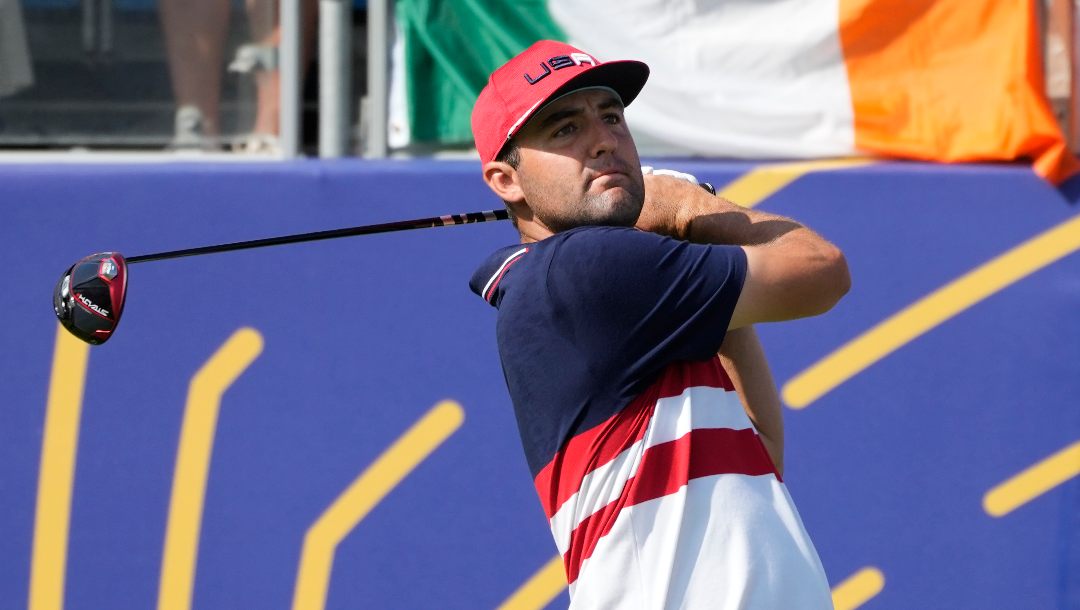
FARMINGDALE, N.Y. — If we’re going to analyze the Ryder Cup — and oh, buddy, are we going to analyze the Ryder Cup — then let’s start at the very beginning, literally, where I’m ready to stand amongst the masses and offer my first proclamation of this highly anticipated week.
We are about to witness some of the most exciting, fearful, thrilling, daunting first tee shots that the game of professional golf has ever enjoyed — or endured.
The tee box for the famed opening hole at Bethpage Black — the one guarded by a sign which warns that it’s only recommended for extremely skilled golfers — has been moved 30-40 yards forward and to the left in order to accommodate a massive build-out which will include at least 5,000 spectators who’ve been impatiently waiting to make their presence known.
The world’s most imperturbable golfers have described the first shot of any Ryder Cup match as such a nervy undertaking that their hands barely stop trembling enough to place the ball on a tee.
In most years, that’s simply the precursor to hitting a decent drive somewhere in the short grass and walking after it to hit it again. This year, though, those trembling hands will also have to deal with a fluttering brain which knows how the player can attack this hole in less butt-clenching conditions.
While it plays 397 yards on the card, those on both sides might decide to aim directly over the trees on the right, cutting the corner and effectively turning the hole into a driveable par-4, just as Bryson DeChambeau did on the opener at Whistling Straits four years ago.
It might not happen right away — the risk could overwhelm the reward in foursomes matches — but the four-balls and singles matches should see plenty of fireworks right from the very start, setting a frenzied tone that won’t dissipate until it’s all over.
That’s everything you could ask for in an opening tee shot, in this environment, in this biennial competition so eagerly awaited that if any golf fan reveals this to be their favorite event, not the Masters or Open Championship or anything else, the common reaction is to simply nod your head in agreement.
Of course, simply suggesting that the first tee will be a wild mix of strategy and energy is hardly the prognostication you’re seeking. Don’t worry, I’ve got plenty more — starting with a pick to win the whole thing.
Team To Lift the Trophy
For years, it’s felt like the warning cry before most editions of the Ryder Cup has been something to the effect of: “The Americans might have a better team on paper, BUT…” followed by advice about Europe’s camaraderie or inspiration or desire or some combination of all three.
This time around, though, it feels like the general sentiment is: “The Europeans might have a better team on paper…” yet there’s no BUT in regard to the U.S. squad’s underlying intangibles.
Even if some American fans are bracing for an onslaught from the road team, the odds have barely wavered for months, with the U.S. remaining a -140 favorite through the FedEx Cup playoffs and the ensuing captain’s picks, then actually getting a tad shorter, moving to -145 coming into this week.
Perhaps this means Euro-leaning sharps are just waiting to click the button. Maybe it suggests American supporters are betting more with their hearts than their heads. Whatever the case, this feels akin to an NFL game where a competent underdog is listed at +7.5 and the oddsmakers are dangling that enticing carrot in front of the public’s collective noses.
(For the record, the European side is +160 to be the “tournament winner” with a tie applicable, +140 to be the tournament winner with a tie being no bet and +115 to lift the trophy — all of which serves as a very important distinction for those bettors playing that side.)
If you’re of the mind that Europe is going to win this week — and if you’re an American fan who doesn’t mind wagering against your allegiance, which is a big “if” — my recommendation is to place this bet sooner rather than later, because there’s a strong chance it evaporates as early as the front-nine during Friday morning’s foursomes session.
I happen to think the U.S. side is going to win this week, for two main reasons: 1) The biggest role for a Ryder Cup captain is to set a tone for his team. Keegan Bradley’s decision to focus on leadership over competition should do just that, getting his 12 individual players to buy wholly into the team concept; and 2) I’m not rooting for it, I’m not hoping it happens and I don’t want to see it, but I do believe the New York crowds will have an impact on the overall result this week. The frenzy will be like a Yankees playoff game, Knicks playoff game, Rangers playoff game and Jets, uh, just a game, all rolled into one and I have a sneaking suspicion that the usual polite golf-spectator decorum will be difficult to maintain.
These fans know there are no mulligans and — again, I’m not rooting for it — it’s hard to believe they won’t want to impart some sort of “wisdom” during the backswings of the European opponents.
All of that said, I have a really tough time advising anyone back the U.S. at this -145 price — especially considering the Europeans swept the opening session two years ago. For me, the play here is to take a wait-and-see approach, then strike when this number gets closer to even-money. That might happen by late-Friday morning or it might take until Saturday afternoon, but the Ryder Cup tends to see massive shifts in momentum and these prices should sway as the performances ebb and flow.
The play: U.S. (-110 or longer), at some point during the first two days
Team to Win the Opening Session
There’s a common misnomer that the European players like each other more than the Americans, which helps to explain why they’re better teammates and better partners and own a better record in the two-man matches, especially the alternate-shot format.
(By the way, the ol’ “camaraderie” issue needs to be put to rest immediately. In no other industry does anyone critique the success of one rival over another by explaining the disparity in group text threads and back-slapping. I mean, we overanalyze the Super Bowl matchup for two weeks every year and yet nobody ever devolves to the point where they debate which team owns the stronger camaraderie.)
The reason it’s a misnomer isn’t because the team bonding thing is untrue. Two or three decades ago, when most of the European players were plying their craft full-time in Europe and traveled to the U.S. in packs, there was probably something to this. Now that nearly everyone lives in Jupiter or Scottsdale, it’s difficult to make this argument.
Really, though, that’s besides the point, because the actual misnomer here is the myth that Europeans dominate the foursomes format.
The truth is, those making this case either can’t remember past two years ago (when the Euros swept the opening session) or can’t do a simple Wikipedia search. There’s a trend here and it’s not about Europeans being better team players or Americans playing as individuals.
Over the past four editions of the Ryder Cup, the home side has dominated this format by a 24½-7½ margin.
What’s the reason for this? Well, maybe you could explain it away by the fact that the partisan crowd has buoyed its players in these opening sessions, but that doesn’t account for 2018 in Paris, when the competition started with the four-ball format, which the U.S. won, but the Europeans held a 6-2 advantage in the afternoon foursomes. Perhaps it has something to do with course setup, though that wouldn’t explain the back-and-forth in the other two formats.
I’m not sure I know the correct answer here — and I’m not sure those who have been a part of these proceedings could offer one — but I do enjoy a bit of trend-spotting and this one has a big neon arrow pointed straight at it. Until this pattern reverses, I like the idea of continuing to play it. And while I suggested above that the U.S. is a wait-and-see play to lift the trophy, I have a sense we might be waiting a little longer for that price to drop if the trend continues this Friday morning.
The play: U.S. to win opening foursomes session (+140)
Team USA Top Points Scorer
Correlative wagering more often occurs in team sports, not golf. If you like the 49ers to cover the spread, you might also want to bet overs for Christian McCaffrey-related props; if you like the Dodgers to surpass their team total, chances are you’ll similarly be intrigued by a few Shohei Ohtani overs.
The occasions for such correlations in golf exist, but they’re rare. Maybe you believe a specific major championship will have tougher-than-usual scoring conditions and therefore take, say, Xander Schauffele in placement markets because the setup should suit him. But again, that’s a rarity.
Remember, though: This week, golf is a team sport and when wagering on it, we should treat it as such. So, if I believe — as I wrote above — that the U.S. team is going to win this week, then it’s hardly a stretch for me to also think that the team is going to need a big performance from Scottie Scheffler to correlate with that victory.
I’m not exactly going out on a limb by choosing the world’s No. 1-ranked player in this market, but this feels like a week where Scottie puts the team on his proverbial back and carries it across the finish line.
In order to win the Ryder Cup, the U.S. team needs at least 14.5 points. Assuming he plays all five sessions, a Scheffler sweep would mean the rest of the team needs to only post 9.5 points in the other 23 matches. That might sound like a daunting task, but it’s hardly precedent-setting. Just four years ago, Dustin Johnson posted a 5-0-0 record for the home side and while DJ was an all-world talent, it would be difficult to argue that he was better equipped for that type of performance than Scottie is right now.
Then there’s the price, which feels like the first value play we’ve gotten on Scheffler in a few years. Just two weeks ago, he was +225 to beat 143 other players at the Procore Championship — which he did, of course. Now he’s almost the same price to post more points than just 11 other teammates on a week when we’re pretty sure he’ll play five matches, which can’t be said about anyone else. He’s still the prohibitive favorite in this market, but there’s value here.
All of this is way easier said than done, obviously, but when doing the math, even the most ardent European backer can envision a path to American success if Scottie does what Scottie has been doing for much of this year.
The play: Scottie Scheffler top USA points scorer (+300); Scottie Scheffler top overall points scorer (+550); Scottie Scheffler to record five points (+1600)
Team Europe Top Points Scorer
If positing a theory on the top U.S. scorer by taking the best player who’s also likely to play five matches isn’t exactly a galaxy-brain exercise, trying to figure out the top European scorer is damn near trigonometry in comparison.
As of this Monday-morning writing, there’s been no indication of exactly what the Euro pairings might look like — and we likely won’t know for certain until captain Luke Donald announces the foursomes pairings during Thursday’s opening ceremony — but it wouldn’t be a surprise if he simply ran ‘em back from that opening 4-0 session in Rome, when Jon Rahm/Tyrrell Hatton, Ludvig Aberg/Viktor Hovland, Shane Lowry/Sepp Straka and Rory McIlroy/Tommy Fleetwood all won without ever getting to the 18th hole.
Less predictable will be which of these players competes in the most matches, which can so often correlate to the points leader.
Two years ago, McIlroy and Hovland were the only players to compete in all five sessions and the former just barely outdid the latter by a half-point to cash tickets in this market. Two years before that, Rahm and Hovland were the only ones to play all five, with Rahm claiming the most points. In the edition before that, McIlroy, Fleetwood and Francesco Molinari played all five, as Molinari was the only one to go 5-0-0, and prior to that, a quintet of players all played five at Hazeltine — McIlroy, Sergio Garcia, Henrik Stenson, Justin Rose and Thomas Pieters — with Pieters winning the most points.
The point (no pun intended) here is that predicting which player will win the most points is a direct parallel to those who play the most matches, as each European player to take this honor in the last four has played every session.
All of which helps explain why McIlroy (+350), Rahm (+500) and Fleetwood (+500) are atop the board in this category.
I’m looking, however, just a bit further down for my favorite play in this market.
While he’s yet to clinch top points scorer, Hovland hasn’t missed a session in the last two Ryder Cups. Knowing that Donald is leaning on stats maven and assistant captain Edoardo Molinari for analyzing potential pairings, I love both the Bethpage course fit for a guy who’s a world-class long-iron player and the fact that he will likely have another player with the same skill set along for the ride in Aberg.
(When asked what language he speaks with the Swede on the course, the Norwegian deadpanned, “Mandarin,” a reply which likely won’t be usurped this week as the best out of a Ryder Cup competitor this year.)
Unlike the U.S., which has a massive disparity between Scheffler and everyone else, there’s less of a differential amongst Europe’s top players, so I love the idea of playing a bigger number on Hovland than chasing the short prices of Rory or Rahm.
The play: Hovland top European points scorer (+900)
Team USA Top Wildcard
There’s never been a more intriguing Ryder Cup captain’s picks announcement than on Aug. 27, when Bradley finally ended all the will-he-or-won’t-he speculation and confirmed that he will serve only in the role of captain and won’t compete on his own team.
Personally, I was ambivalent about the decision before it was announced.
If Bradley wanted to play on his team, he’d earned that right as one of the 12 best U.S. players throughout the past year. If he chose to sit out, that was certainly understandable, as well.
Almost immediately, though, when he announced his decision, it felt like the right call. This was the ultimate sacrifice for a player who so obviously loves this tournament. It’s not pairings or course setup or uniforms which are the most important aspects of being a captain. It’s setting a tone for the players — and Bradley instantly made it clear that the team comes before any individuals.
Think about it: In prior years, a player might’ve groused about not competing in a certain session. This year, if a player even starts to grumble, Bradley can remind him that he gave up his spot on the roster for that guy, so he’s preaching to the wrong choir.
All of that said, we’ve still gotta figure out which one of ‘em is going to earn the most points — Sam Burns, Patrick Cantlay, Ben Griffin, Collin Morikawa, Justin Thomas or Cameron Young.
The easy pick here is Cantlay — and oftentimes, the easiest pick is also the correct pick. Other than the major championships, he played extremely well this season without winning, and he’s already got a presumably built-in partnership with Xander Schauffele.
Thomas is (somehow) the elder statesman on this team and potentially a team leader. Burns might get some run with Scheffler if Russell Henley falters. Griffin continues to play like one of the best in the world. And the much-maligned Morikawa seems like a weak spot based on recent play, but might surprise a lot of people on a course that doesn’t necessarily suit him.
If you’re scoring at home, you’ll notice I didn’t mention one player — and that the New York native Young, who’s my pick in this market.
The big hitter owns experience on the Black Course and might have the second-best form of anybody on the roster, finishing 11th or better in each of his last five starts.
Since his first career victory at the Wyndham Championship, Young has looked and sounded like a different player, more comfortable in his own skin and confident in his abilities. Don’t be shocked if his normally stoic persona melts amidst the hometown fans, not unlike the exuberance displayed by David Duval back in 1999 at Brookline.
My early-week guess is that he might get a match or two with DeChambeau — potentially in the four-ball format, which could be a ham-and-egg birdie-fest.
The key in this market — just like top overall points scorer for each team — is picking a guy who will play more matches than the others. I think some early success from Young could have him as a momentum play by Bradley, as he could simply ride the hot hand. Granted, we can say the same for any of the other five wildcards, but it feels like Young has unlocked something in the past two months, which should be perfect timing for the biggest event of his life.
The play: Cameron Young top U.S. wildcard (+500)
Team Europe Top Wildcard
After Donald announced his captain’s selections, Sergio Garcia was reportedly so distraught by his exclusion that he immediately withdrew from that week’s DP World Tour event. That might sound like a natural reaction for a player who loves this event, but it’s also an idealized one, considering the likes of Marco Penge, Harry Hall, Alex Noren, Aaron Rai, Thomas Detry and Nicolai Hojgaard each would’ve/should’ve been named to the B Team before Garcia anyway.
The reality is, these might’ve been the least controversial wildcard picks in recent Ryder Cup memory, as Donald wound up with 11 of the same players from two years ago, only switching out Nicolai for his twin brother Rasmus, who qualified on points.
The players named to the team are a far cry from the reaches that European captains used to make in order to fill out a roster. Aberg, Hovland, Lowry, Rahm, Straka and Matt Fitzpatrick form a veritable all-star team compared with the Andrew Coltarts and Stephen Gallachers of yesteryear.
I won’t bore you with the repetitive analysis of my pick here.
Even if you were just skimming to this point, you might’ve noticed that I took Hovland for top European points scorer, so it stands to reason that I probably like him for top wildcard, as well. In fact, if you can’t see past a guy like McIlroy, Rahm or Fleetwood in that other market, perhaps this instead is a more palatable play on Hovland, though at a much shorter price.
The play: Viktor Hovland top European wildcard (+375)
Tournament Exact Score
If you’re like me, then you tend to look at the weekend’s football lines, find 7-8 college/pro games you really like, then decide, “What’s the point in betting each one of these individually when I can just parlay ‘em all and win a boatload?”
(Note to reader: I really hope you’re not like me.)
For those who aren’t content to simply pick a winning side and try to cash a ticket, you can pick a winning side *and* the correct final score, an offer which feels eminently winnable until you attempt to parse through half-points, some of which might be irrelevant to the overall result.
Just as a seemingly meaningless last-minute touchdown pass can turn a bet that was winning all day into a loser, all it takes is one conceded putt to alter the final score.
Of course, if you’re like me — and again, I really hope, for your sake, that you aren’t — you’ll probably read those words as: All it takes is one conceded putt to alter the final score AND CASH YOUR EXACT SCORE WAGER.
Hey, it’s a fun bet. And with scores from 14-14 to 16-12 for either team all within about seven points as far as price, there really isn’t any hidden value here. It’s just pick your favorite score and cross your fingers for three days. You know, kind of like those football parlays.
The play: U.S. wins, 15½-12 ½ (+1100)
Visit the BetMGM online sportsbook for weekly PGA Tour odds and more golf betting opportunities.
Whether you want to bet on tournament winners, build multi-sport parlays, or place live bets, there’s endless entertainment for every type of golf fan. And keep an eye on sportsbook promos — including a sportsbook welcome offer for new customers — throughout the year for Odds Boosts, contests, and more.

The content provided in this blog is intended for entertainment purposes only. All views and opinions expressed are the authors and reflect their individual perspectives on sports, betting, and related topics. This content should not be considered professional betting advice or the official views of BetMGM LLC. Please gamble responsibly. If you or someone you know is experiencing issues related to gambling, seek help from a licensed health professional. This blog is not liable for any losses, damages, or consequences resulting from betting activities.