





FARMINGDALE, N.Y. – For the first time in 13 years, the Ryder Cup finally offered some Sunday drama.
A furious rally from the U.S. team proved to be too little, too late, as the European side retained the title by a score of 15-13.
The session, though, changed plenty of narratives from the imbalance of the first two days – and left us with plenty of reactions to everything we witnessed this week.
Here are 10 of ‘em:
The U.S. players really do care about this event.
Apologies to those who already read this take on Twitter, but I believe it so much that I wanted to use the same wording here.
There’s an old saying in golf: It has to mean everything and it has to mean nothing at all.
That sounds contradictory, but there’s plenty of truth to it. Essentially, a player must care wholeheartedly about both the process and performance, yet compete with an unbothered mindset.
I know most American fans will argue that the Europeans simply care about the Ryder Cup more, but I see it differently. I believe the U.S. team collectively has enough “mean everything,” but doesn’t have any of the “mean nothing at all.”
There’s obviously a delicate balance here, but the Europeans have found it, and I think it helps explain what we’re witnessing so far this week – and every two years, for the most part.
Alright, so how do they fix it? Again, this is less of a band-aid and more of a cultural upheaval.
This is difficult to assess without access to the behind-closed-doors team-room atmosphere. From an outsider’s perspective, though, I believe the players would probably benefit from less of a “this means everything” attitude, which can only promote a higher level of pressure.
None of which is to excuse any of this away as, “The team lost because the players were too emotionally drained so early in the week.” It’s about finding that balance of ensuring the players desperately care about winning this event, then releasing them from that strain and allowing them to play with unburdened minds.
Continuity and stability are of the utmost importance.
Whether you liked the outside-the-box idea of Bradley as captain or not, whether you feel like a big part of this loss in on his shoulders or not, it’s impossible not to feel awful for a man who was undoubtedly thrust into this position too early in his career and will carry this L with him forever like a scarlet letter.
If the idea had worked, it would’ve validated everything the “task force” purported to be working on – namely, giving the current players more of an ownership role and greater investment in the product.
It didn’t work, but that doesn’t mean the powers-that-be with the PGA of America need to go all the way back to Square One.
I’ve long believed that this position should be one that remains in perpetuity, not unlike coaches for other U.S. national teams. It’s a theory that has only been enhanced by Europe’s decision to retain Luke Donald after the victory in Rome, building on that notion of continuity.
As it turns out, the right man for the job just might be waiting in the wings.
Tiger Woods quietly turned down the captaincy for this year’s Ryder Cup before it was offered to Bradley, but there are already murmurs within golf’s inner circles that it’s a done deal that the 15-time major champion will be at the helm in Ireland.
Some might point to Woods’ team record – he played on just one winning side in his career, and that was back in 1999 – as rationale for looking in another direction, but if you know of another person in this country more qualified for the gig, I’d like to hear it.
Woods remains deeply connected with most of these players. He’ll have their ear, he’ll get their attention and he’ll provide a level of gravitas in the team room which hasn’t been around since the Jack Nicklaus and Arnold Palmer captaincies.
It might not be enough, though, to announce Tiger as 2027 Ryder Cup captain. Instead – with his blessing, of course – just name him Ryder Cup captain. Just like any position, it would be his until the day when he didn’t want it anymore or those in power didn’t want him to have it.
The idea of passing the baton and letting a different player in the twilight of his career be the captain should be over. There’s greater benefit in stability. If you don’t believe that, just ask Donald and his European players.
This team needs a Fixer – capital F – and there’s no one better to take that role than Tiger.
So is team camaraderie, for that matter.
Riddle me this, golf fans: Why is it that the American team has been decried as an insular Boys Club, yet the Europeans have been lauded for their ability to enjoy each other’s company?
We can’t simultaneously argue that one side doesn’t win because it’s only comprised of guys who pal around together, while the other side wins specifically because it’s comprised of guys who pal around together.
As if the U.S. hadn’t already been saddled with enough losses this week, allow me to take another: Before this week’s proceedings began, I insisted that camaraderie was overblown and players getting along wouldn’t equate to success.
Oops.
Maybe it’s a chicken-or-the-egg conundrum – do players win who have better camaraderie or do players with better camaraderie win? – but it was clear from the beginning that the European vibes were unlike anything even close to those on the American side.
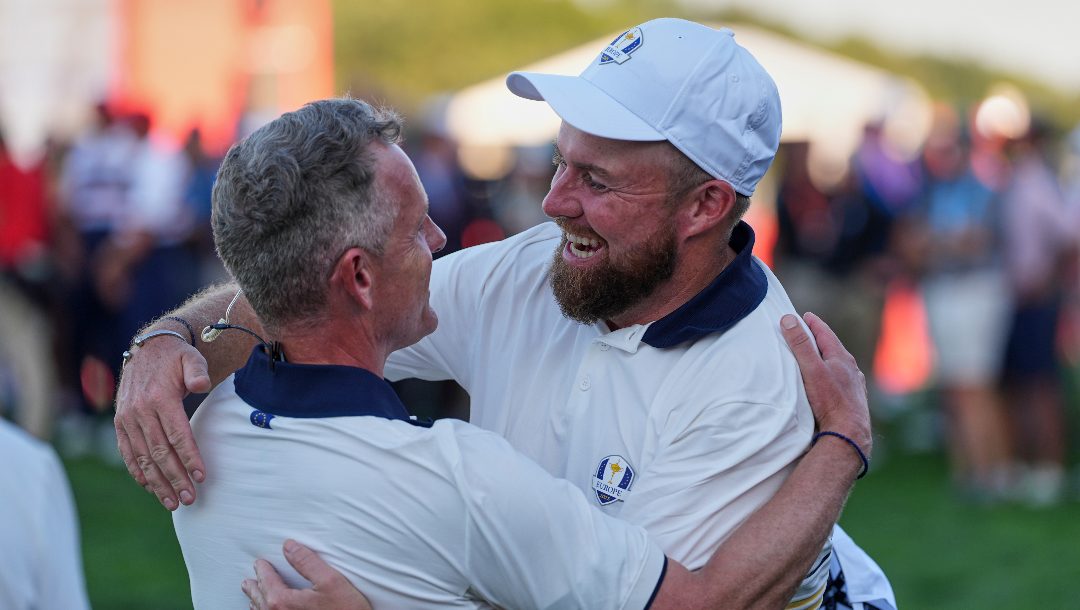
Whether it was Shane Lowry ready to throw down with some New York fans who’d repeatedly disparaged Rory McIlroy or Tommy Fleetwood and Justin Rose hugging each other more than a newlywed couple, it was obvious that the European players wanted to win as much – or even more so – for the others on that team than themselves.
How does the U.S. replicate that sense of fellowship? Another great question – and another which doesn’t have a black-and-white solution.
Here’s my take: If this was an upper-level college course, the Europeans would be the ones putting in the work from Day 1. They’re doing the assigned readings, studying each night, and ensuring that they’ll be well prepared for the final exam. The Americans put it on the back burner, something they’ll get to later after their other classes. Then it gets down to crunch time, and they find themselves cramming for the big test and hoping for the best.
None of which offers a solution, I’ll admit.
Should Sam Burns and J.J. Spaun spend every Tuesday during the PGA Tour season playing alternate-shot matches against fellow players? Do Harris English and Ben Griffin need to hang out for two years, just in case they’re teammates again?
All of that sounds wildly exhausting – and those who have been critical of the U.S. side for not figuring things out would probably giggle at these pained ideas to correct it.
The answer lies somewhere in continuity for the team and a cultural shift in how these players approach the Ryder Cup.
Analytics are a real thing, kids!
We’re more than two decades removed from being introduced to Moneyball and yet, mention the word analytics to a large portion of sports fans and they’ll scoff at the idea.
Maybe we’re collectively scared of crunching numbers. Maybe we just want the players to play better, dammit. (How very Tom Watson circa 2014 of us.)
Whatever the case, there are those who believe that processing data should be left for CPAs and success in sports is only about talent and desire, not any predictive metrics.
European captain Luke Donald doesn’t believe that. Two years ago, he enlisted Edoardo Molinari as vice captain – and in turn, Molinari, a disciple of stats guru Mark Broadie, helped unearth the best strategic tactics for everything from setting up the golf course to pairing players.
It worked like a charm.
The Europeans swept the opening foursomes session, then trotted out a completely different lineup in the afternoon four-ball format. The next day, though, they went back to the same alternate-shot tandems once again.
None of this was about which player wanted to play alongside a buddy or how they’d fared together in the past. They’d looked at the numbers and figured out how and why certain duos would work.
To his credit, Bradley didn’t disparage the use of analytics. He maintained that the team had crunched the numbers and used it during the decision-making processes, but only in vague terms. And really, if they were employing the data, there were some questionable interpretations.
The one that will linger the longest was the decision to pair Collin Morikawa and Harris English in foursomes, which, according to Data Golf, was the least optimal pairing on the U.S. team. After they lost handily on Friday, Bradley doubled down by sending them back out together on Saturday, which resulted in another defeat.
When asked whether this arrangement was based on the analytics, the captain said, “We have a plan of what we’re going to do. … We’re really comfortable with our plan. We’re really comfortable with those two players … and we’re sticking to our plan. We’re not going to panic.”
Europe had a plan, too – and that plan very obviously gave them a mathematical edge in some matches during the first four sessions.
Everyone has a plan until…
Not to belabor the Morikawa/English decision – or benching U.S. Open champion J.J. Spaun during the first two foursome sessions – but plans are meant to be broken when situations arise.
And the Americans undoubtedly took a few haymakers to the temple early on.
Like an offensive coordinator intent on establishing the running game when down three touchdowns in the first half, it felt like it took the American side too long to adjust accordingly.
Of course, there’s an extremely delicate balance here.
If you’re down 3-1 after the opening session, you can’t immediately detonate the entire strategy on which you’d spent months working. At some point, though, if Plan A isn’t working, you need to move on to Plan B or Plan C.
All of this ties into the point I made above about continuity. Those who have been involved in this process previously might’ve known when and how to make certain adjustments.
And the envelope, please.
Sports fans haven’t heard this much discussion about an envelope since the 1985 NBA Draft. (IYKYK, kids.)
Prior to Sunday’s singles session, Viktor Hovland was forced to withdraw with a neck injury. That meant his match would be rendered a tie, giving a half-point to either side.
Coincidentally – or maybe not so coincidentally? – enough, his match was scheduled to be against English, whose name was “in the envelope” for the U.S. side, meaning he’d be the player benched in this scenario that took place.
The idea of this harkens back generations, to when this event was largely a goodwill competition between the U.S. and Great Britain & Ireland.
It was more of a gentleman’s match then, without the heated rivalry that it’s turned into on both sides of the ledger.
These days, though, it feels antiquated – a notion Bradley suggested in the post-match press conference.
“It needs to change by the next Ryder Cup,” he said matter-of-factly.
Yes, this happened in 1991, as well, and yes, it helped the U.S. side that week, but Bradley isn’t wrong about this rule moving ahead into the current era.
Look, it was less than 50 years ago that GB&I was expanded to all of Europe in order to make this more competitive. This event isn’t immune to rules changes and this one should be near the top of the list, whether it means having an alternate on hand or simply taking a loss due to injury.
Speaking of rules changes…
For a while there, toward the end of Sunday’s play, it looked like the final score was going to be 14-14, which probably had some novice observers confused, considering Shane Lowry had already holed the clinching putt.
Of course, the defending champion in this event has always needed only 14 points to retain the Ryder Cup, while the challenger needs 14½.
It’s always been that way, and even if it ended as a draw this time, it wouldn’t be sour grapes to suggest that this, too, is an antiquated rule that needs revising.
Oh, trust me: More than a few Europeans very, very politely reminded me on Twitter that some cricket matches and other sporting events follow the same guideline of retention in case of tie, but that doesn’t mean it’s the proper outcome.
There aren’t many ways the Presidents Cup beats its more established big brother, but this scenario is settled in a head-to-head playoff in that competition, which sounds a whole lot more entertaining.
And that’s what this is, when it’s all said and done – entertainment. Give me Scottie Scheffler and Rory McIlroy playing one hole with the entire Ryder Cup on the line.
Thankfully, there was no draw this time, helping avoid this awkward debate over the next two years. But again, that doesn’t mean it shouldn’t change.
This looked more like Bethpage Bleak.
There’s a famous sign behind the first tee here, which warns those with a tee time that it’s an extremely difficult course recommended only for highly skilled golfers.
That wasn’t the case this week.
As anyone who’s slept in this parking lot overnight can tell you, the Black was more tame than it usually is on any random summer afternoon. With very little rough and (for some unknown reason, considering there was no rain after Thursday) playing preferred lies each day, these players essentially turned one of the game’s toughest tests into a pitch-and-putt.
This was, obviously, at the behest of the home team, which may set up the golf course however they’d like.
The last time a Ryder Cup venue played tougher was at Le Golf National in Paris, where the fairways were pinched, the rough was thick and the pins were often tucked. That played into the hands of a European team which favored precision over power, but a lot has changed in seven years. These teams were virtually identical in many ball-striking categories, so the setup shouldn’t really have benefited either side.
Of all the ways this U.S. side could’ve performed better, of all the ways it could’ve gained an advantage over the Europeans, I’m still not buying the idea that a more difficult setup was one of ‘em.
Do I wish it had played tougher? Yes, but only because that’s the hallmark of this place. It would’ve been fun to see pars winning some holes, rather than birdies in such abundance, but I can’t get behind the notion that the Americans shot themselves in the foot by not making this place tougher.
Some stars shined brighter than others.
Ranking the world’s best golfers – either via formula or the ol’ eye test – is a fluid exercise. Whatever you believe this week will probably change soon enough, then it’ll change again.
It wasn’t too long ago that Tommy Fleetwood was the epitome of, well, maybe not “Nice guys finish last,” but at least “Nice guys don’t finish first.” His final-hole failure at the Travelers Championship was tough to watch and he continued coming close without a victory cigar.
That all changed at the Tour Championship, when he won the FedEx Cup for his first victory on U.S. soil. Now it looks like he might never lose here again. Fleetwood went 4-1-0 this week, losing only to Justin Thomas on a final-hole birdie. Scheffler and McIlroy are clearly 1-2 in the world right now and while you might rank Jon Rahm or Bryson DeChambeau or Xander Schauffele at No. 3, Fleetwood can at least stake a claim to that spot.
Don’t be surprised if all this success bleeds into bigger things during the 2026 campaign.
The same could be said for Cameron Young, who tied for the most points on the U.S. team in his first Ryder Cup appearance. A native of New York, he spoke often during this year about how much he wanted to make the team and he proved he belonged, rolling in a final-hole birdie of his own to knock off Justin Rose in singles.
I promise I’m not going to make a Scheffler comparison as far as talent or impending success, but just as Scheffler used his 2021 performance at this event as a springboard to bigger and better things the next year, I think Young – who already looks and sounds more comfortable in his own skin than prior to his first career win at the Wyndham Championship – is ready to take that next step as a top-10 type of player in the world who can win multiple times in a season and challenge for a few more major championships.
Start spreading the booze…
I grew up about 20 minutes from Bethpage State Park.
When the PGA of America announced on Sept. 17, 2013, that the Black would be hosting the Ryder Cup, I immediately knew that mayhem was going to ensue.
In fact, you don’t have to be from New York to understand this phenomenon. If you believed this was going to be a demure crowd that graciously cheered good shots from both teams, you were more naïve than anyone who thought they could get to the course this week without any traffic.
That’s not to excuse any of it, of course.
The spectators here were boorish, disrespectful and flat-out vulgar at times – especially to McIlroy, who heard catcalls he never could have imagined while prepping for this one with his VR headset.
The one thing that I’ll point out to those who watched on TV, though – and again, not to excuse any of it – is that making the sweeping generalization of “all those New York fans” belittling the European team is sort of missing the point.
I’ve written multiple articles in the past where I spoke with ticket-holders who yelled obnoxious things at golf during tournaments. Most of them admitted that it was childish, but also said a healthy dose of encouragement from those around them – not to mention a healthy dose of alcohol – was at play.
Here at Bethpage, it turned into a copycat crime. With spectators packed into each hole and not being able to follow the matches, they knew they’d get one chance to make an impression on the European side.
It was ugly. It was rude. But it was hardly unexpected.
And if McIlroy thought that was bad from the New York folks, well, let me just tell you about being a middle school kid around here with glasses, braces and a bad haircut.

Visit the online sportsbook for all golf betting opportunities this week and throughout the year.
Whether you’re a first-time bettor using a sportsbook welcome bonus, a casual fan betting on Masters odds, or a longtime diehard breaking down weather trends for The Players Championship, there’s entertainment for everyone.
And always keep an eye on the best sportsbook promotions for an Odds Boost, free-to-play contest, and more!
The content provided in this blog is intended for entertainment purposes only. All views and opinions expressed are the authors and reflect their individual perspectives on sports, betting, and related topics. This content should not be considered professional betting advice or the official views of BetMGM LLC. Please gamble responsibly. If you or someone you know is experiencing issues related to gambling, seek help from a licensed health professional. This blog is not liable for any losses, damages, or consequences resulting from betting activities.