





- College football general managers play a crucial role as off-field executives.
- An SEC program hired the first official college-level GM in 2016.
- General managers can come from a variety of different backgrounds.
It’s the most en vogue position in modern college football. Fans, players, and coaches are increasingly focused on a relatively new phenomenon: the college football GM, or general manager.
General managers are emerging as a critical prerequisite for success in the era of professionalized collegiate sports and NIL. Still, the position is new enough that many fans don’t quite understand what it is they do.
In this article, I’ll do my best to explain what a college football GM is, how the position came to exist, what their job responsibilities are, and how their presence (or absence) connects back to the college football odds market.
What Is a College Football General Manager?
A college football general manager is a senior off-field program executive responsible for building and managing a program’s roster of players.
In the modern era of college football, that means a GM plays a heavy role in overseeing the high school recruiting, transfer portal activity, scholarship allocation, NIL strategy & coordination, and compliance regulation.
The Evolution of the College Football GM Position
Throughout most of the 20th century, schools would limit most of their baseline recruiting activity to drivable high schools or other prep areas. There was a high degree of regionality to most college sports.
As college football budgets evolved and large-scale travel became more common, high-level NCAA recruiting became more national in the late 20th and early 21st century. The increasing complexity of recruiting generated a need for specific coaching oversight. It became common for one assistant coach on any given staff to be tabbed as the RC, or Recruiting Coordinator.
That position began to evolve in the 2000s. In 2006, Georgia Tech assistant Geoff Collins successfully convinced his administration to award him a new title: Director of Player Personnel, or DPP. While this was a common title in professional sports, it was the first documented time that any NCAA program had used it to describe one of its coaches.
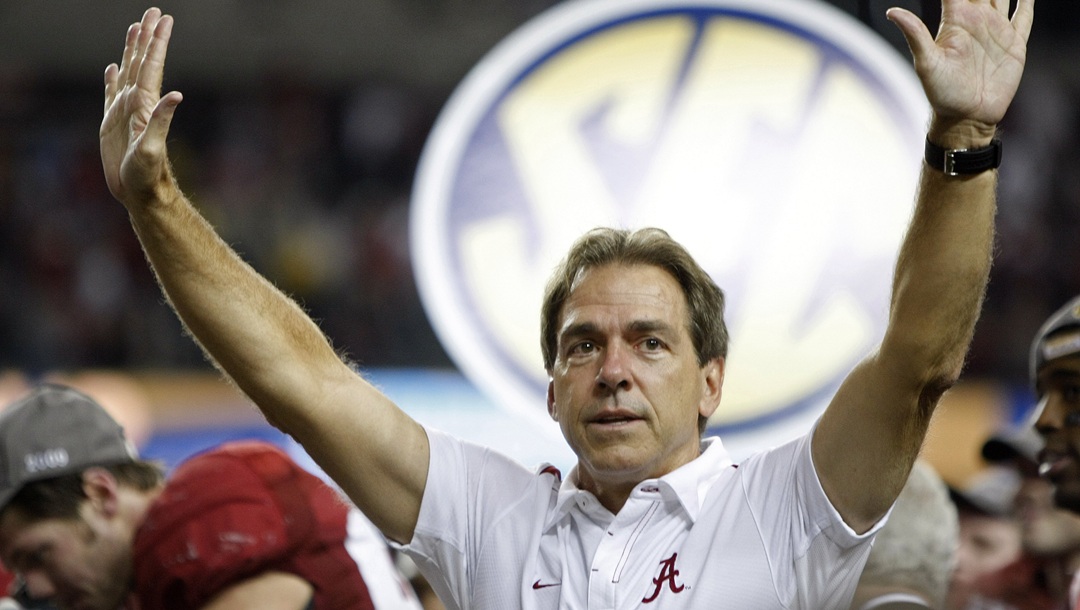
Almost immediately, the DPP position was seen as a value add by one of college football’s visionary coaches. One year after Collins earned a groundbreaking job title, Nick Saban was hired at Alabama.
Saban, who was coming off a stint as an NFL coach with the Miami Dolphins, made it a priority at Alabama to build an NFL-style personnel department. Previous reporting from Alex Scarborough and others suggests that Saban believed he could build his eventual Alabama empire on the back of a huge recruiting edge.
Saban hired Collins to be his first DPP in ’07. He won his first national championship in 2009, and followed it up with additional titles in 2011, 2012, 2015, 2017, and 2020.
As the 2010s wore on, and Alabama kept winning, other coaching staffs made an effort to learn what was powering Saban’s program. It wasn’t long before other programs began hiring Directors of Player Personnel.
That need for an off-field personnel executive paved the way for a GM. LSU hired Austin Thomas to be the program’s general manager in 2016 – the first known use of the term for an NCAA program.
Nearly 10 years later, most power conference football programs employ a GM on staff in some capacity. Any college football program working without a GM these days is probably not a serious championship contender – at the national level, sure, but also the conference level, too.
OK, But What Does a College Football GM Actually Do?
The most important job college football GMs have is roster management. With college rosters now pulling heavily from both traditional preps recruiting and the NCAA Transfer Portal, the year-to-year management of a 100-person roster that includes 85 scholarship players is exponentially more complex than it used to be.
But there are other elements that a GM must also juggle. The general manager is often a liaison between the football program and other important stakeholders, like NIL collectives or the university administration.
Handling off-the-field issues like money, politics, and roster management allows the head coach, coordinators, and other key assistants to remain mostly focused on the actual football part of the job.
How Does Someone Become a College Football GM?
Most college football coaches and professionals start as players. They subsequently become graduate assistants and work their way up. So from the broadest possible perspective, that’s the most common path to becoming a GM – or any other kind of coach.
The most common path to a GM is likely the Player Personnel lane. Just as Collins saw 20 years ago, there’s a need for a Director of Player Personnel at most modern FBS programs. Coaches that move in that direction – as opposed to continuing to work with players specifically on the field – are often well-positioned to take on a GM job.
But that’s not the only way to become a GM. At power conference programs in particular, a successful GM could be hired from an NFL background, since they would have particular insight into how to identify and develop younger players toward a potential NFL future. When Bill Belichick was hired at UNC, he brought in longtime NFL expert Michael Lombardi to be the new GM in Chapel Hill.
Other programs have completely zagged on their GM background, opting to maximize the business end of the college program by bringing in someone with a more business-heavy background. That could even include marketing experience, since that CV would dovetail with some NIL goals.
One example of this is Michigan, which hired Sean Magee as its GM in 2024. Magee has some “classic” background – he had previously worked as a DPP under Jim Harbaugh – but he also has an MBA and served as a naval officer for nearly 10 years. He also spent two years as the Chicago Bears’ Chief of Staff.
Magee has exactly the kind of wide background that is likely to make him successful in a complicated, multifaceted job like a college football GM. Five years from now, I would expect to see more guys with strange CVs in this role.

College Football Betting at the Online Sportsbook
BetMGM is the best online sportsbook for college football betting.
Whether you’re a first-time bettor browsing spreads for SEC games, a casual fan building a moneyline parlay for early Saturday games, or a longtime diehard tracking over/under trends in windy games, there’s something for everyone.
If you’re new to the online sportsbook, register today with a sportsbook welcome bonus. And check out sportsbook promos each time you log in.
The content provided in this blog is intended for entertainment purposes only. All views and opinions expressed are the authors and reflect their individual perspectives on sports, betting, and related topics. This content should not be considered professional betting advice or the official views of BetMGM LLC. Please gamble responsibly. If you or someone you know is experiencing issues related to gambling, seek help from a licensed health professional. This blog is not liable for any losses, damages, or consequences resulting from betting activities.